Research
My research uses experimental, econometric, and machine-learning methods to estimate the causal effects of policy on mobility, sustainability, and welfare. Where available, abstracts and links are provided below.
Publications
Pigovian Transport Pricing in Practice
Forthcoming in Review of Economic Studies
Abstract
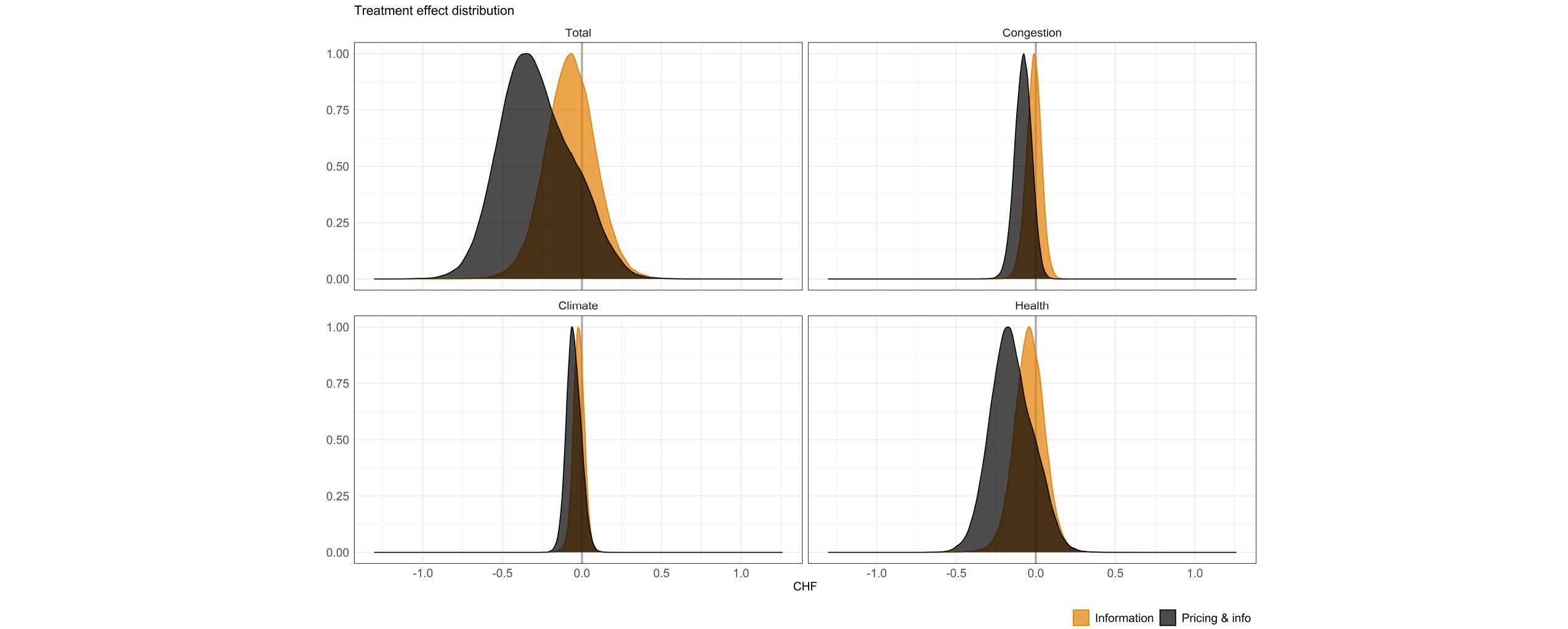
We implement Pigovian transport pricing in a field experiment in urban agglomerations of Switzerland over the course of 8 weeks. Our pricing considers the external costs from climate damages, health outcomes from pollution, accidents and physical activity, and congestion. It varies across time, space and mode of transport and is deducted from a budget provided to GPS-tracked participants. The treatment significantly reduces the external costs of transport during the course of the experiment. The main underlying mechanism is a shift away from driving towards other modes, such as public transport, walking and cycling. Providing information about the external costs of transport alone is insufficient to change the transport behavior for the sample majority. A time-invariant tax on CO₂ and health-related externalities would capture most of the welfare gains associated with the first-best policy.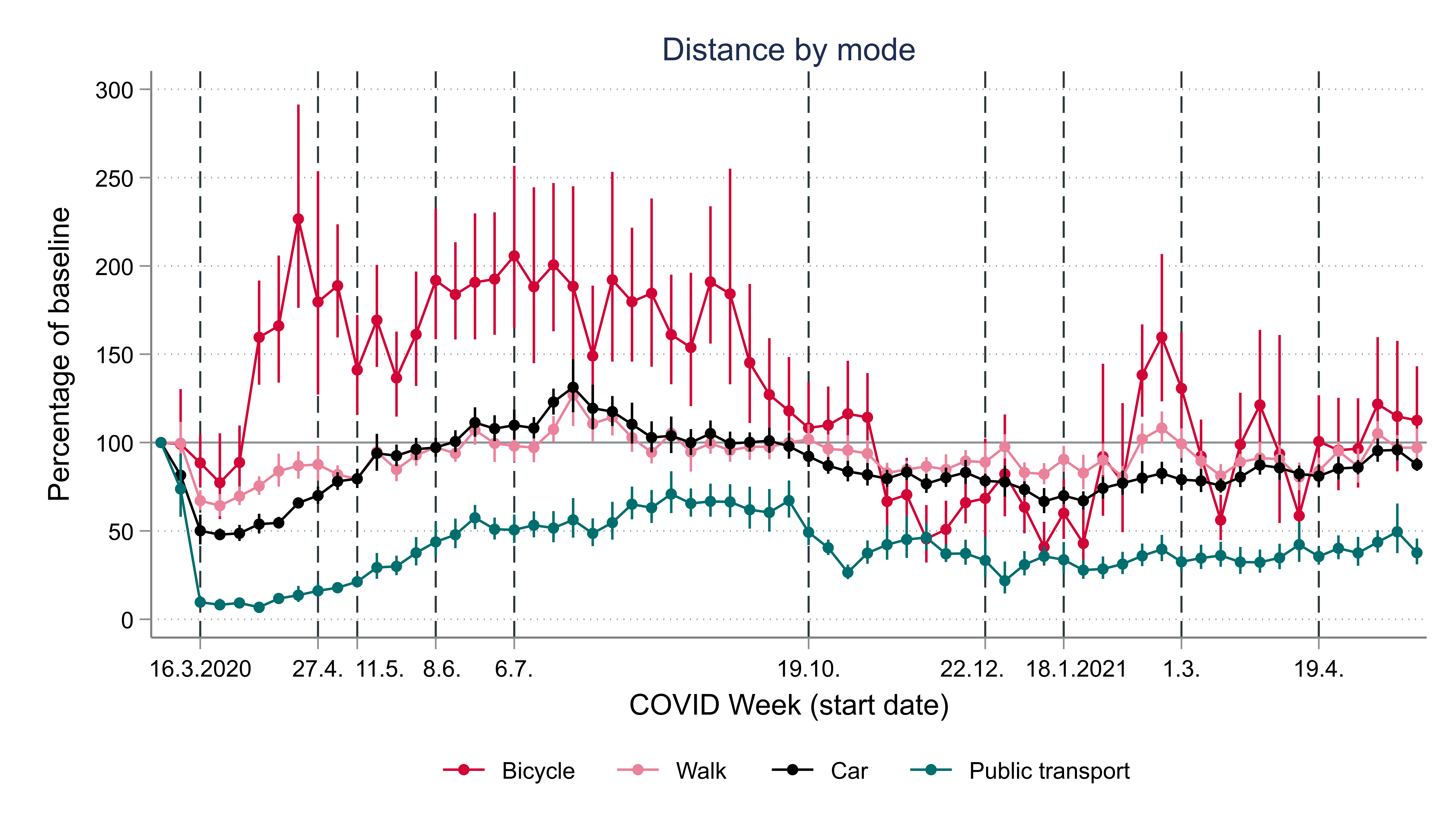
The Impact of COVID-19 on Mobility Choices in Switzerland
Transportation Research Part A: Policy and Practice · 2023
Abstract
We study the effect of the COVID-19 pandemic and the associated government measures on individual mobility choices in Switzerland. Our data is based on over 1,600 people for which we observe all trips during eight weeks before the pandemic and until May 2021. We find an overall reduction of travel distances by 60 percent, followed by a gradual recovery during the subsequent re-opening of the economy. Whereas driving distances have almost completely recovered, public transport remains under-used. The introduction of a requirement to wear a mask in public transport had no measurable impact on ridership. The individual travel response to the pandemic varies along socio-economic dimensions such as education and household size, with mobility tool ownership, and with personal values and lifestyles. We find no evidence for a significant substitution of leisure travel to compensate for the reduction in work-related travel.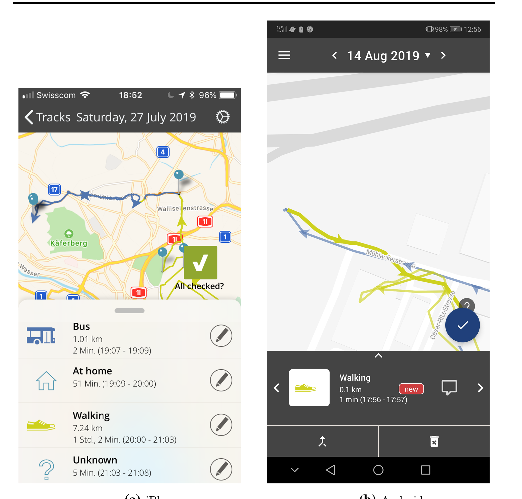
The MOBIS Dataset: a Large GPS Dataset of Mobility Behaviour in Switzerland
Transportation · 2022
Abstract
This article presents the MOBIS dataset and underlying survey methods used in its collection. The MOBIS study was a nation-wide randomised controlled trial (RCT) of transport pricing in Switzerland, utilising a combination of postal recruitment, online surveys, and GPS tracking. 21,571 persons completed the first online survey, and 3680 persons completed 8 weeks of GPS tracking. Many continued tracking for over a year after the study was completed. In the field experiment, participants participated through the use of a GPS tracking app, Catch-my-Day, which logged their daily travel on different transport modes and imputed the trip segments and modes. The experiment lasted 8 weeks, bookended by two online surveys. After the first 4-week control phase, participants were split into two different treatment groups and a continued control group. This paper also reports on the wealth of data made available for further research, which includes over 3 million trip stages and activities, labelled with transport mode and purpose, respectively.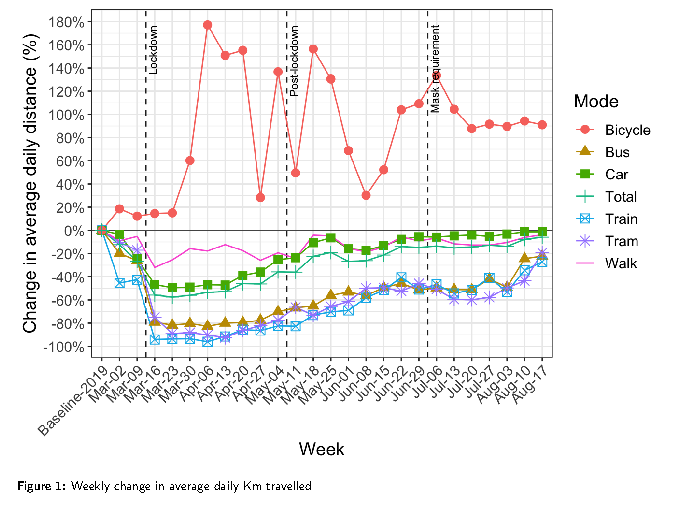
Observed Impacts of the COVID-19 First Wave on Travel Behaviour in Switzerland Based on a Large GPS Panel
Transport Policy · 2021
Abstract
In Switzerland, strict measures as a response to the Covid-19 pandemic were imposed on March 16, 2020, before being gradually relaxed from May 11 onwards. We report the impact of these measures on mobility behaviour based on a GPS tracking panel of 1439 Swiss residents. The participants were also exposed to online questionnaires. The impact of both the lockdown and the relaxation of the measures up until the middle of August 2020 are presented. Reductions of around 60% in the average daily distance were observed, with decreases of over 90% for public transport. Cycling increased in mode share drastically. Behavioural shifts can even be observed in response to the announcement of the measures and relaxation, a week before they came in to place. Long-term implications for policy are discussed, in particular the increased preference for cycling as a result of the pandemic.Working papers
Cash Transfers and Bargaining Power in Multigenerational Households: Theory and Evidence from South Africa
Under review · 2026
Abstract
I extend the revealed-preference framework of Cherchye et al. (2015) for the household sharing rule — the share of resources allocated to each decision maker — from two members to m. This matters because households of three or more co-resident adults are common in lower-income settings, and the two-person version mechanically overstates an individual’s share. I apply the extended framework to the South African Older Persons Grant, a large means-tested transfer that acts as a plausibly exogenous income shock, using a fuzzy regression discontinuity design on five waves of panel data. Pension receipt raises the recipient’s sharing-rule bound by about 8% (income elasticity of about 0.15), with gains concentrated among female and unmarried recipients. Receipt also lowers labour-force participation for the recipient and other household members, leaving total household income roughly unchanged.Work in progress
These are preliminary, incomplete drafts. Please do not cite or circulate without permission.
Willingness to Pay for Environmental Policies: An Experiment with Interactive Maps
Abstract
This project uses a survey experiment to elicit people’s willingness to pay for environmental policies, and their willingness to pay to have information about these policies presented through interactive maps. Together, these valuations show how much the public values both the policies themselves and their accessible, map-based communication. The project is in its design phase.Working from Home and Vehicle Electrification as Levers for Transport Decarbonisation: Evidence from Switzerland
Abstract
Transport accounts for a third of Swiss final energy use and is the sector furthest from the 2050 net-zero target. Two demand-side developments shape its outlook: the diffusion of working from home (WFH) and the electrification of the vehicle fleet. Using a stated choice experiment with 1,098 respondents, we estimate how Swiss adults adjust mobility-tool ownership and travel demand in response to these changes. We find that transport energy reductions accelerate as WFH intensity rises from a no-WFH baseline: roughly −8% at one WFH day per week, indistinguishable from zero at two days, and progressively larger from three days onward at −12%, −20% and −20% for three, four, and five WFH days respectively. The direct rebound elasticity from switching an internal combustion vehicle to an electric vehicle is modest at 0.04, so about 96% of the engineering efficiency gain translates into realised energy savings. Vehicle size matters substantially more than rebound: an SUV uses 63% more energy per kilometre than a small car, a penalty that electrification only partially offsets. Combining EV adoption with full WFH cuts annual car energy by 80% per adopter. For WFH, the aggregate picture is more modest: applying the Swiss schedule from the Global Survey of Working Arrangements (46% of Swiss workers can WFH; adopters average 1.65 days per week), the share-weighted reduction in commute-related transport energy attributable to WFH is only about 3%, an order of magnitude smaller than the 38% we obtain under a 50% EV fleet share.Carbon Pricing, Sectoral Channels, and Distributional Incidence: Evidence from Germany’s BEHG
Abstract
Germany’s 2021 carbon price on transport and heating fuels (the BEHG) preceded the EU-wide ETS2, providing early evidence on how such a price affects emissions and households. Using a synthetic difference-in-differences design across Germany’s 401 districts, with European regions as a donor pool, I decompose the policy’s effect into a transport and a residential heating channel. The estimates indicate a robust reduction in transport emissions, while the residential channel displays a counterintuitive increase in particulate concentrations consistent with a shift toward biomass heating during the gas crisis. The paper further quantifies consumer pass-through, the distributional incidence of the burden across districts, and the role of Klimageld revenue recycling. Austria’s analogous carbon-pricing scheme serves as an independent comparison case.Crisis-Born Capital: Endogenous Investment and the Private Response to South Africa’s Loadshedding Crisis